
The Time of Mary

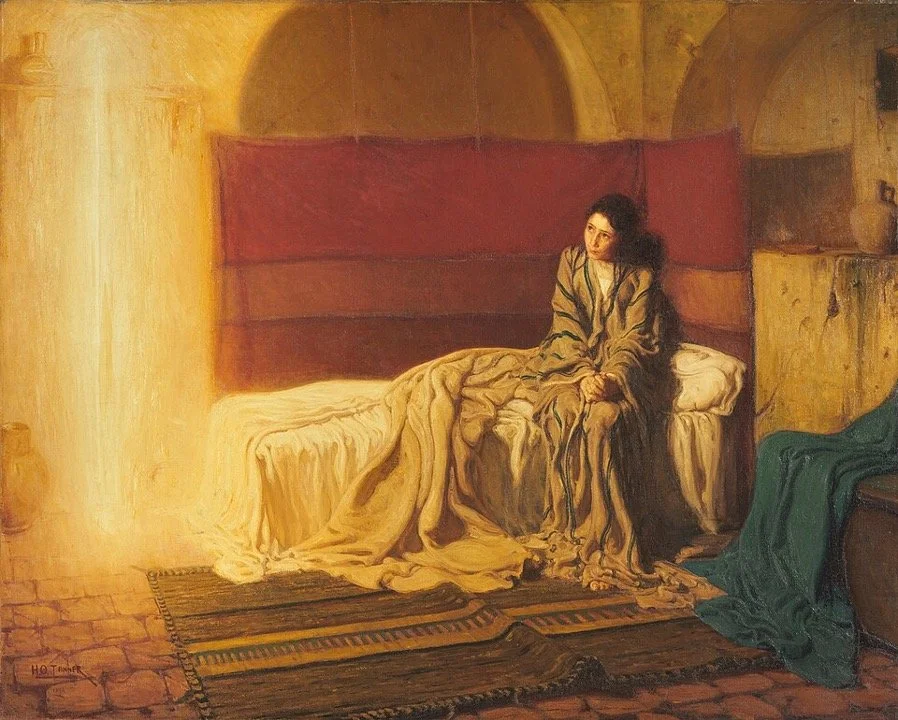
Source: The Annunciation by Henry Ossawa Tanner (1899), in the Philadelphia Museum of Art

My favorite painting of the Annunciation is by the African American realist artist Henry Ossawa Tanner. In Tanner’s Annunciation, the angel appears as a column of light. As for Mary, she isn’t a demure, passive girl. She is a young woman who leans forward with a quizzical expression on her face. Tanner’s Mary has real questions, and Tanner treats the Annunciation as a real event that happened to a real person in a real place - which is what it is. This painting takes seriously the fact that in that universe-upending moment, Mary could have said no but didn’t.


I think sometimes people grow up with a two-dimensional, cardboard-cutout version of Mary. But the Mary of Scripture is more complicated and interesting than that. She is a woman of faith and courage. Here’s how the British Anglican poet Denise Levertov describes the scene:


Called to a destiny more momentous
than any in all of Time,
she did not quail,
  only asked
a simple, ‘How can this be?’
and gravely, courteously,
took to heart the angel’s reply,
the astounding ministry she was offered:
to bear in her womb
Infinite weight and lightness; to carry
in hidden, finite inwardness,
nine months of Eternity; to contain
in slender vase of being,
the sum of power–
in narrow flesh,
the sum of light.
This was the moment no one speaks of,
when she could still refuse.
A breath unbreathed,
                                Spirit,
                                          suspended,
                                                            waiting.
Bravest of all humans,
                                  consent illumined her.


In this last, suspended moment of Advent, we are in the time of Mary. Christmas is a time to rejoice in the glory of the Lord, but it’s also a time to be confronted by the very human reality of the story of Jesus’ birth. Neither Mary, nor Joseph, nor Jesus, are two-dimensional figures acting out a sentimental tale. They are real people, caught up in the most real situation possible: the situation of God’s action towards us in the Word made flesh. It is a time of awe. It is a time of joy.


May the blessing of our newborn Savior be with each of you this season.

Yours in expectation,

Kara+

Advent: The Beginning of the End of All in Us Not Yet Christ

Inspired by Thomas Merton

Thomas Merton, in his Advent essay Hope or Delusion, writes that Advent is “the beginning of the end of all in us that is not yet Christ.” With that single line, he invites us to step away from any sentimental or Hallmark-style picture of the season. Advent is not a time of nostalgia. It is not a gentle manger scene meant to soothe us. Advent confronts us with the truth of Christ’s birth within the broken, chaotic reality of our lives and our world.

The Incarnation is not sentimentality — it is reality. It is God choosing to enter the world as it is, not as we wish it were. And so, Advent asks us to do the same. It calls us to look honestly at who we are and the difference between our lives and the life of Christ, and at the hopes we carry. Is our hope grounded in the real, living Christ, or is it about an illusion — a kind of spiritual pixie dust we imagine will make everything right without asking anything of us?

Advent, therefore, is not sacred sentimentality or ecclesial escapism. It is a moment of truth — the truth about ourselves, the truth about our world, and the truth about what God is bringing to birth within it. Merton’s insight reminds us that Advent is both invitation and challenge: the call to let the false power of our egos fall away, and to surrender our hearts to the transforming grace of God.

So let us rejoice and give thanks in this season of beginnings —
a season that marks the beginning of the end of all in us not yet Christ,
and the beginning of Christ being born in us anew.

Advent Blessings,

Paul+

Preparing a Way

Jesus said to the disciples, “But about that day and hour no one knows, neither the angels of heaven, nor the Son, but only the Father. – Matthew 24:36

Last weekend, a group from Trinity Church gathered at the Community of St. John Baptist in Mendham for a time of prayer and discussion as we look towards Advent. To spend time in prayer in such a beautiful setting was a gift, and if you’re reading this I hope you will consider joining us for our next retreat in March!

During our discussion of the Advent Gospels for Year A – the readings that we’re about to hear in church between now and Christmas – we explored what it might mean to “prepare the way of the Lord” in our hearts and our lives. As we developed a list of concrete practices as a group, we thought you might find it helpful too.

This Advent, you may want to try:

·      Reading a chapter of the Bible or praying a Psalm before you pick up your phone.

·      Changing your Instagram or Spotify algorithm by following more church-related content.

·      Read the Advent devotional from Trinity (I Witness, available at church) or another devotional book

·      Listening to the podcast of Morning Prayer or Evening Prayer from Forward Movement.

·      Listening to sacred music. Try this playlist of upcoming music from our choir, or this playlist of my own favorite Advent songs.

As I have led retreats over the past few years, probably the most common insight I hear from folks is how much it changes your experience of the world to put your phone away. It sounds clichéd by now, but the presence of phones in our pockets is one of the most serious spiritual challenges of our time. This Advent may be a time to re-examine your relationship with your phone - and to reflect on whether or not that relationship needs to change. I know I will be doing that myself!

In the coming days of Advent, we will see the love of God for this world. This is a love so complete that in God’s good time, “the way things are” will be transformed into “the way things should be.”  It is a love so complete that we will know conclusively that the only possible logic of the world is one of peace, of harmony, of new life, of love and redemption. We will know this because the knowledge of God’s truth will fill the world. No longer will we see dimly or guess at God’s designs. We will know at long last what Julian of Norwich saw in her vision: “Would you know your Lord's meaning? Know it well, love was his meaning. Who showed it to you? Love. What did he show you? Love.” This indeed is something to prepare for – not just by decorating our homes and getting all the festive foods ready, but by making a path in our hearts.

Yours in Christ,

Kara+

CHRIST THE KING

Dear Beloved of Trinity Church,

This Sunday, we celebrate Christ the King Sunday, the final feast of the liturgical year. It is a day that proclaims Christ’s cosmic reign and gently ushers us toward the season of Advent—a time of longing, expectation, and hopeful preparation for the coming of the King.

Yet our human imagination often struggles with kingship. We picture power wrapped in grandeur: thrones and jeweled crowns, palaces and pageantry, subjects bowing before a distant ruler. We imagine hierarchy, dominance, and the wide gap between those who reign and those who serve.

But Christ the King redefines kingship entirely. This feast—also called The Reign of Christ Sunday—invites us to consider the day when God’s world is set right, when divine order and justice are restored. In Christ, power is never about coercion or control. It is always about freedom, healing, and liberation. As Rowan Williams reminds us, “Christ reigns not by taking power, but by giving it away; not by domination, but by self-offering.” His is a kingship shaped by humility, mercy, and sacrificial love.

Fleming Rutledge adds, “The day Christ comes in glory will not be a day of triumph for the powerful, but liberation for the captive.” It will be a day when the last are lifted up, the broken are restored, and the forgotten are brought home.

Christ the King Sunday invites us to look beyond the crowns and kingdoms of this world and to imagine a different kind of rule—one where love is the law, service is strength, and every captive heart is set free. May this vision prepare us as we enter Advent with renewed hope and holy expectation.

Peace and Blessings,

Paul+

The Other Triduum

This weekend, western Christians around the world will observe what sometimes is called the little Triduum: the three days of All Hallows Eve, All Saints Day and All Souls Day. It’s a parable or a signpost of the other triduum: Maundy Thursday, Good Friday, and the Easter Vigil. Both of these sets of three days confront us with the truth about death and resurrection. The Triduum of All Saints is about our death and resurrection, and the Triduum of Easter is about the death and resurrection of Jesus Christ. It is his death and resurrection that makes our resurrection possible.

 If we look at historical and contemporary debates, there have been a lot of words spilled on the relationship between All Saints’ Day and All Souls’ Day. What does it mean on All Saints’ Day that we celebrate the saints? What does it mean that All Souls’ Day is also called the commemoration of all the faithful departed?  A more Catholic approach would say that the saints are special examples of holiness that have been recognized as such by the church. All Souls’ Day, then, is for all of us faithful who die in the sure and certain hope of the resurrection.

A more Protestant understanding might follow the logic of Martin Luther, who says that we are all sinners and yet we are all equally saints redeemed by the cross of Christ. As the famous hymn goes, “there’s not any reason, not in the least, that I shouldn't be one too.”  But regardless of which theological position you take, the message of this week is simple: resurrection. This weekend we remember those who have joined the company of faithful departed before us, and perhaps we will meditate on our own mortality as well. But above all, I hope that you will remember God’s “yes” to you, spoken at Easter that is good news for each one of you.

Yours in Christ,

Kara+

The Future Begins Today!

Dear Trinity Family,

It’s that season again — the time when we, the people of Trinity, turn our hearts and attention toward how we can support our beloved church in the year to come through our gifts of time, talent, and treasure.

Stewardship is a vital part of maintaining a healthy and thriving community. It’s about more than just financial giving — it’s an investment of our hearts, our energy, and our faith in the mission and ministry we share.

Below you’ll find a letter from our stewardship co-chairs, Bill Hackett and Cindy Westbrook. We are deeply blessed to have these two faithful leaders guiding us in this year’s effort.

Please take a moment to read their letter prayerfully, and to consider how you might support the ongoing work and witness of our beloved Trinity Church.

The Future begins today!

Peace and blessings to all,

Paul+

The World as We Know It… Is Ending

Dear Beloved of Trinity Church,

A week or so ago, the clergy of the Diocese of New Jersey gathered in Toms River for our annual Fall Clergy Conference—two and a half days of learning, reflection, and fellowship with Bishop French and the Rev. Gay Jennings, former President of the House of Deputies and member of the Presiding Bishop’s staff.

One recurring theme throughout our time together was that we can no longer live with a status quo mindset. “Business as usual” is no longer sustainable. The world around us is changing—rapidly—and these changes compel us to make intentional choices about how we live out our ministries in an ever-evolving society.

One of the phrases that framed our discussions was:

“The world as we know it is ending.”

In truth, that’s been the case since the beginning of time. The world is always changing. Yet, today, the pace and scope of that change are unlike anything humanity has ever experienced. Transformation that once unfolded over centuries or decades now happens in years, months, even weeks. New ideas, technologies, and global connections are reshaping our lives at an unprecedented rate.

So how do we live faithfully in such a rapidly changing world—anchored in the timeless truth of the Gospel?

With that question in mind, I invite you to join me this Sunday during our Adult Forum for a conversation shaped by six questions adapted from our clergy discussions. My hope is that this conversation will help us deepen our shared understanding and prepare us thoughtfully and prayerfully as we approach our Annual Meeting on November 9.

We need to be intentional, prayerful, and proactive as we discern together the future of our ministry at Trinity.

Here are the questions we’ll explore:

  1. What do we need from each other?

  2. What do you need from your clergy?

  3. What do the clergy and leadership of Trinity Church need from you?

  4. How can we best support one another?

  5. What would be the signs of a strong community and a strong church?

  6. What is our fundamental job as the Body of Christ?

The world as we know it is ending—and we have a vital role to play in what is being created anew. Filled with the Holy Spirit, empowered by God’s love, and sustained by God’s grace, we are invited to help shape the world that is coming into being.

And that, my friends, is exciting.

Forward in Faith!

Paul+

Hospitality

Dear People of Trinity Church,

Recently, I’ve been spending time with Henri Nouwen’s Reaching Out: The Three Movements of the Spiritual Life. One section that especially caught my attention is titled “Reaching Out to Our Fellow Human Beings.” In it, Nouwen reflects deeply on the biblical idea of hospitality—“one of the richest biblical terms that can deepen and broaden our insight into our relationships with our fellow human beings.”

Nouwen offers a powerful reimagining of what hospitality truly means. It is so much more than simply welcoming a stranger. He writes, “The Dutch use the word gastvrijheid, which means the freedom of the guest.”

Hospitality, Nouwen explains, “means primarily the creation of free space where the stranger can enter and become a friend instead of an enemy. Hospitality is not to change people, but to offer them space where change can take place. It is not to bring men and women over to our side, but to offer freedom undisturbed by dividing lines. It is not to lead our neighbor into a corner where there are no alternatives left, but to open a wide spectrum of options for choice and commitment. It is not an educated intimidation with good books, good stories, and good works, but the liberation of fearful hearts so that words can take root and bear fruit.”

Hospitality, then, is a way of liberation—for both the host and the guest, the one who welcomes and the one who is welcomed. It frees us from our preconceived notions, prejudices, and suspicions. It opens our hearts and minds to the possibility that something new and wonderful might happen in the space between us.

True hospitality says not, “Come, and you will become one of us,” but rather, “Come, and together we will discover something new.” It creates a space in which truth and grace, diversity and unity, can coexist. In that space, we begin to see one another not as strangers but as bearers of gifts to be shared—gifts that bless both giver and receiver.

In this particular season of our church’s life—and in our national life—may we practice this liberating, life-giving hospitality. May we rediscover the freedom that bears the fruit of love, community, grace, and healing.

Peace and Blessings,

Paul+